Jack–Marion Ruthven
Young Captain Jack · The Son of a SoldierJack–Marion Ruthven is both a legal relationship created by adoption and an emotional alliance tested by secrecy, war, and competing claims about Jack’s parentage. Marion’s insistence that Jack belongs to the Ruthven family gives him his first durable answer to the accusation that he is a nobody, while her conduct during his disappearance shows that their siblinghood is defined less by blood than by recognition, care, and protective action.
Identity and Foundation
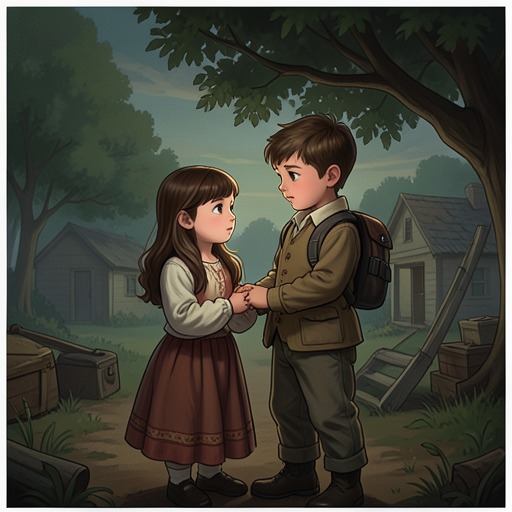
Marion is presented as Jack’s sister within the Ruthven household, and she explicitly explains that her parents adopted him when he was about three or four years old. She therefore treats him as her brother even while acknowledging that he was not born a Ruthven. When Jack is shaken by the claim that he does not belong to the family, Marion tells him that he is not a nobody and that he is John Ruthven, her own brother. She further argues that, in the eyes of the law, he is her real brother because her parents adopted him, making legal family status a direct counter to the social insult directed at him.
The relationship is established against a missing past. Marion tells Jack that he had been a passenger on the wreck that came ashore on Hemlock Bluff rocks between ten and eleven years earlier. Old Ben found him on the beach in the arms of his injured mother, and Jack retained only a dreamy fragment of the storm and its enormous waves. The household preserved the few objects connected with that episode: the clothing, an unmarked lace handkerchief, and a ring worn by his mother. Marion’s willingness to recount these details places her in the role of family witness, connecting Jack’s present identity to the household’s memory of his rescue rather than dismissing him because his birth is unknown.
Mutual Care During Crisis
Marion’s relationship with Jack becomes most visible when the Ruthven household is drawn into wartime danger. After the fighting, she works over the wounded George Walden, trying to restore him to consciousness when the available surgeon has gone to the battlefield. She tells Jack that the soldier is badly hurt and that he knows Dr. Mackey, adding that Walden regarded Mackey as a fraud who had never been married. The information is important to Jack’s identity conflict, but Marion’s part in delivering it is inseparable from her practical care for the wounded and from her confidence that Jack should know what may affect him.
When Jack disappears, Marion does not treat the absence as a minor family quarrel. She and Mrs. Ruthven order Old Ben and the others to search again, and the hunt continues far into the night without result. Marion asks whether the Yankees could have captured him, but immediately measures that possibility against her knowledge of Jack’s character: he would not leave without telling the family or deliberately cause them anxiety. Her concern therefore rests on intimate knowledge, not merely on the household’s need to locate a missing young man.
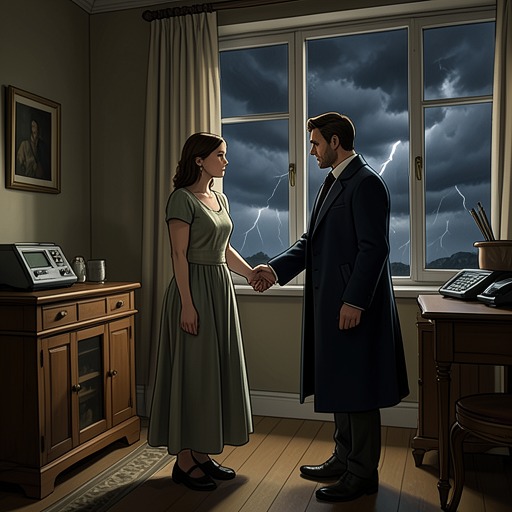
The same protective loyalty appears in her defense of Jack when St. John Ruthven arrives with Confederate soldiers. St. John claims that Colonel Stanton is a spy and says the soldiers will arrest him. Marion answers that the soldiers will instead be surprised to find Dr. Mackey already a prisoner. Her response protects Jack’s position and opposes an attempt to turn the household’s refuge into an instrument against him and Colonel Stanton. She also sharply condemns St. John as cowardly and unprincipled, refusing to let family connection become an excuse for silence.
Identity Claims and Family Loyalty
Jack’s relationship with Marion is repeatedly strained by competing versions of his parentage. At first, the threat comes from the suggestion that he is merely a nobody who will eventually have to leave the Ruthven family. Marion’s account of the adoption gives him a familial and legal identity, but it cannot answer the question of who his birth parents were. The ring and handkerchief preserve evidence without immediately providing a name; the ring’s worn marking could not be read even after two jewelers inspected it.
The uncertainty then becomes more dangerous when Dr. Mackey declares that he is Jack’s father. Jack reacts with astonishment, while Marion’s broader knowledge of the case helps keep the claim from becoming the final explanation. Later, she receives the revelation that Jack is not Dr. Mackey’s son but the son of Colonel Stanton, whose fevered speech has connected a shipwreck, his wife Laura, and a son named Jack. The resemblance between Jack and the wounded colonel, together with the recovered history, shifts the story from an adopted boy’s uncertainty to the recognition of a biological father and son.
Marion’s role in this reversal is not to erase the adoption. She had already defined Jack as her brother under the law and within the household, and the discovery of Colonel Stanton’s parentage does not undo the care that preceded it. Instead, the revelation makes the relationship more complex: Jack can become Colonel Stanton’s son without ceasing to be Marion’s brother. The narrative thus separates biological origin from the daily and legal work of family belonging.
Recognition and Narrative Significance
After Jack learns that Colonel Stanton is his father, he remains with him for more than an hour before turning to the problem of Dr. Mackey. Marion continues to stand beside him during this transition. When the Confederate soldiers arrive, her announcement that Dr. Mackey is a prisoner helps prevent St. John from arresting Colonel Stanton and makes the family’s combined knowledge and action stronger than the false accusation brought against them.
The recovery of the black tin box from the wreck of the Nautilus completes the evidentiary pattern surrounding Jack’s past. The box, found hidden in a filthy, water-damaged closet within the wreck, contains papers later returned to Colonel Stanton. Stanton identifies them as his precious papers and tells Jack that nothing now stands between them and their fortune. This material proof confirms the family history that had previously survived through memories, resemblance, fevered words, and preserved personal objects. Marion’s sibling relationship provides the emotional continuity through all those changing explanations.
Jack–Marion Ruthven therefore represents the novel’s distinction between origin and belonging. Jack moves through several identities—adopted Ruthven, unidentified survivor of the Hemlock Bluff wreck, alleged son of Dr. Mackey, and finally Colonel Stanton’s son—but Marion consistently treats him as her brother. Her testimony, caregiving, search for him, and resistance to St. John’s intervention make the bond an active force in the plot. The eventual confirmation of Jack’s birth does not replace the Ruthven relationship; it demonstrates that family can be both inherited and made through adoption, memory, protection, and steadfast recognition.